

Showing posts with label php. Show all posts
Showing posts with label php. Show all posts
Monday, December 9, 2013
Create Custom Validation with namespace using Laravel 4 (Part 1)

Monday, October 14, 2013
Complete Guide on how to Install Laravel 4 in Linux Ubuntu
Upgrade PHP 5.3.x to 5.4.x in UBUNTU 12.04
Saturday, June 8, 2013
Send email from localhost WAMP server using sendmail

Most of applications today are sending email to their subscribers or followers. During development stage, we need to test how this emails will look like. So, today we're going to configure our Wamp server to send an email. Here's the steps to achieve this:
Friday, January 11, 2013
Laravel - A Clean & Classy framework?
Saturday, March 10, 2012
Connect WAMP 2 server to PosgreSQL Database
For those who want to connect to PosgreSQL using WAMP as your server, just follow the procedure and you'll be ready to start!
Sunday, November 27, 2011
Fastest PHP Framework
A web application framework is designed to support the development of dynamic websites, web applications and web services. It aims to alleviate the overhead associated with common activities performed in development such as database access, templating frameworks and session management, and it often promotes code reuse.
I have been coding Web Applications using PHP for a while and I find frameworks as very useful. It has an MVC (Model-View-Controller) approach, enforces good coding standards, has helpers and components which makes my coding life easier and saves me a lot of time and effort with its features. I and my officemates have been using CakePHP as our PHP framework for awhile and we think that its performance is becoming slow. We're thinking of trying out CodeIgniter, another famous PHP framework, but it makes me wonder, if it really is the fastest and most feature friendly framework we are looking for?
I did some research and I found DooPHP has quite an interesting portfolio.
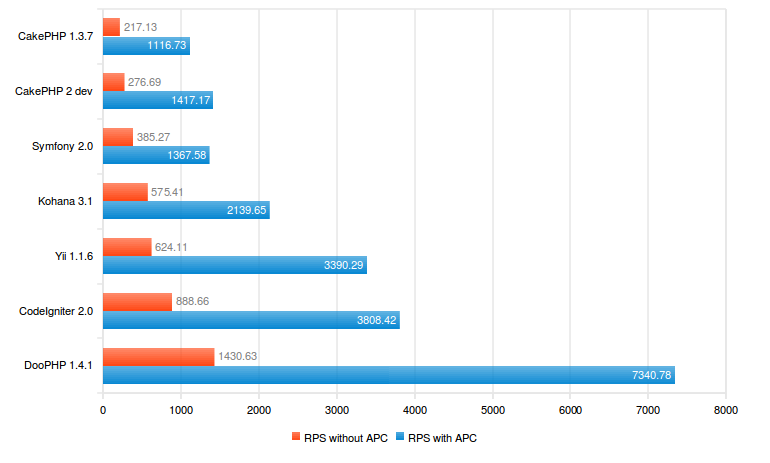
Quite interesting right? What's not to like in this framework? Well for me, since it is still relatively new (started in 2009), I don't think it has a wide support base unlike its predecessors. Also, it feels like a hybrid framework. Why? One of the reasons why we use frameworks is because of its support for MVC.
function signup_action() {
/* Set the pages title */
$this->data['pagetitle'] = 'Signup';
// Load the User Model
Doo::loadModel('User');
// Get a new User Model Instance
$user = new User;
// Try and find a User with the specified username
$result = Doo::db()->find($user, array('limit' => 1));
}
In this example, we can see that it is accessing its data through the controller. That is not a good practice for "FAT MODELS, THIN CONTROLLERS" approach. It destroys the ideal MVC. Sure, it is faster but maintainability and reusability wise, it could be a pain in the future. For small scale projects, this could work since maintainability won't be much of an issue. Also, I get the feeling that it is like I am using classic PHP because I have to do/declare everything by myself as shown below:
Doo::loadCore('db/DooModel');
class User extends DooModel {
    public $id;
    public $username;
    public $password;
    public $group;

    public $_table = 'user';
    public $_primarykey = 'id';
    public $_fields = array('id', 'username', 'password', 'group');

    function __construct(){
        parent::$className =;__CLASS__;
    }
}
The closer you are to classic PHP, the faster your codes will be. Rasmus Lerdorf, the Godfather of PHP himself, believes that frameworks aren’t that great because they perform much slower than simple PHP. If you have to use a PHP framework, Rasmus likes Code Igniter the best, as it is "least like a framework"[2008]. We all have different needs, different wants and it all boils down to which framework will suit it. DooPHP is still young. It might be the fastest because it is almost similar to classic PHP, but it might be problematic in terms of scalability. Maybe after a few more years and this will be a framework to watch out for!
For now, I think I'll stick to CakePHP and will try its new stable version 2.0. :)
Other helpful resources:
DooPhp model guide
Learn DooPhp
10 Principles of the PHP Masters
CakePHP Best Practices: Fat Models and Skinny Controllers
Friday, November 25, 2011
JSON encode auto sorting issue
JSON is used to send data as an object either be an array or string.
I used AJAX to pass on my data from server to client. My intention was to populate a drop down list with values dynamically. I had created my array list as show below:
$result = array( '5' => 'a', '2' => 'b', '3' => 'c', '4' => 'd', );
echo json_encode(array( 'result' => 'success', 'details' => $result ));
I was expecting to see my array as is, but I was confused when I checked my JSON result array was as shown below:
array { result: "success", details: [{ 2: "b", 3: "c", 4: "d", 5: "a" }] }
See the problem? My array values were automatically sorted out. I found out that this is a browser issue with Google Chrome. I checked this using Firefox and there was no problem. So what is the solution to this problem? There are two ways:
- Don't use json_encode. I used this method because I realized I didn't really need to populate my dropdown list dynamically. I just needed static data for selection.
- Sort it out before appending to its drop down element.
// data.details came from json_encode in the example above.
//arrVals should be an array.
var arrVals = data.details();
arrVals.sort(function(a, b){
    if(a.val>b.val){
        return 1;
    }
    else if (a.val==b.val){
        return 0;
    }
    else {
        return -1;
    }
});
Hopefully, Google Chrome will fix this bug so we won't encounter this again or performance will not be wasted.
Sources:
Sorting (dropdown) Select Options Using jQuery
Sort a select list box
Wednesday, November 23, 2011
CakePHP vs CodeIgniter
Web application framework, a software framework for development of dynamic websites, web applications, and web services
Nowadays, framework is important for us to create an agile, self-documented and organized Web Application. There has been a long fuss between these two great frameworks: CakePHP and CodeIgniter. But the question still remains, which framework should I choose? Read on to find out.


Both CodeIgniter and CakePHP are best suited for object oriented programming and support the Model View Controller architecture which provides robustness and flexibility to a great extent. CakePHP is the better one when it comes to robustness and strictness of conventions, which is appreciated by a section of the programmer community because it is easy to remember. On the other hand, venturesome programmers see this as a shortcoming in CakePHP. CodeIgniter has a wide built-in library that serves most of the purpose of a beginner in PHP programming. For those ahead of the rest, CodeIgniter lets them create their own libraries or rather classes within those libraries barring the database classes. There are certain simple naming conventions that need to be followed. The flexibility of creating custom classes and modifying existing native classes is something highly appreciated by radical programmers, always itching to create something different. CakePHP on the other hand, is more in demand with hard core PHP guys for its robustness and superior auto-load features. ORM is another strong point of CakePHP. In terms of speed, CodeIgniter wins hands down.
Both CakePHP and CodeIgniter has an active community and is open-source so development and improvements are continuously being done. They say clarity of documentation and online support community of CodeIgniter is far better than CakePHP, which makes it the framework of choice for toddler programmers and experts alike. For me, I prefer the documentation of CakePHP. Recently, they updated their website and I like the changes because now the community can edit the documentation. It is also easily searchable and well-organized; There is a blog tutorial that will easily help you jumpstart in getting used to CakePHP.
Bottomline, if you're a beginner you're best bet will be using CodeIgniter because it is closer to classic PHP, faster to learn, easy to use and fast. Otherwise, choose CakePHP for its strict MVC, robustness, data sanitation, and support for PHP4 and PHP5.
Subscribe to:
Posts (Atom)